
Conceptos financieros
Direct vs indirect cash flow: differences and when to use each method.
Complete guide on direct vs indirect cash flow: what sets each method apart, how to calculate it with numerical examples, when to use each, and what the Spanish PGC requires.
Introduction
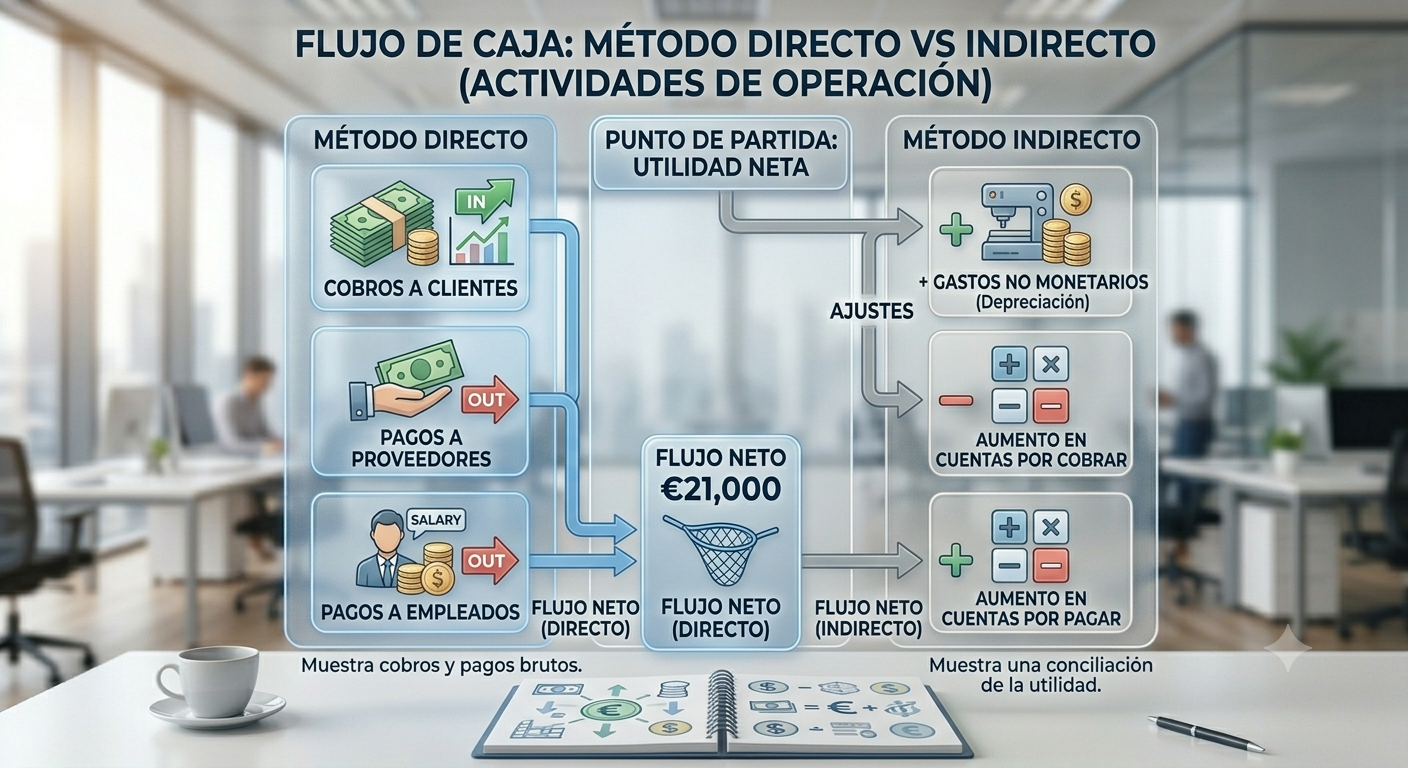
When someone talks about "doing the cash flow" in a company, they're really talking about two very different things that often get confused: the direct method and the indirect method. Both produce the same final figure — the net change in cash for the period — but they calculate it in completely different ways and serve different purposes.
Understanding the difference isn't just an accounting matter. It's understanding what kind of question each method can answer: do I want to know why my cash has changed compared to the accounting result? (indirect) Or do I want to know exactly where money comes from and goes every day? (direct).
In this guide we explain what each method is, how to calculate it, when to use which, and what the situation is in Spain from both a legal and management perspective.
What is the cash flow statement (CFS)
The cash flow statement is one of the five financial statements that make up the annual accounts under the Spanish General Accounting Plan of 2007 (PGC 07). Its purpose is to explain how the company's cash and cash equivalents have changed during the period.
Unlike the income statement — which works on the accrual principle and records revenue and expenses when they're generated, regardless of whether they've been collected or paid — the cash flow statement works with real cash movements. That's why a company can show a positive net profit in the P&L and at the same time see its cash decrease.
The cash flow statement classifies movements into three blocks:
- Operating activities: those generated by the main business activity (customer collections, supplier payments, payroll, taxes).
- Investing activities: those related to purchases or sales of long-term assets (equipment, financial investments).
- Financing activities: those linked to the capital structure (loans, share issuance, dividend payments).
The difference between the direct and indirect method affects only the first of these three blocks: operating cash flows. The investing and financing blocks are always calculated using the direct method, both under IAS 7 and the PGC.
Legal framework in Spain: what the PGC and IAS 7 say
Before getting into the technical differences, it's worth clarifying the regulatory framework in Spain, because it has a peculiarity that matters for any controller or CFO.
This has practical consequences:
- Spanish companies that prepare annual accounts under the PGC (the majority) present the cash flow statement using the indirect method for operating activities and the direct method for investing and financing.
- SMEs that can prepare abbreviated accounts or follow the PGC-PYME are not required to present the cash flow statement, although it's highly recommended for management reasons.
- Companies that apply IFRS (listed companies or consolidated groups) can choose between both methods, although in practice the vast majority also use the indirect method due to its lower preparation cost.
The important distinction is this: the PGC regulates the mandatory accounting presentation. But for internal financial management — the cash flow the CFO uses to make decisions, forecast liquidity or analyse the business — the company can and should build the method that helps the most.
The direct method: what it is and how to calculate it
What it measures
The direct method calculates operating cash flow by directly adding up real cash receipts and subtracting real cash payments. It doesn't start from the accounting result: it starts from the bank movement.
The logic is as simple as reviewing your bank statement and classifying each movement: collection of invoice X from customer A, January payroll payment, quarterly VAT settlement, payment to supplier B, etc.
Direct method structure
| Operating flows — Direct method | Amount |
|---|---|
| + Customer collections | +€1,250,000 |
| − Supplier payments | −€820,000 |
| − Personnel payments (payroll + SS) | −€180,000 |
| − Tax payments (VAT, CIT, PIT) | −€95,000 |
| − Other operating payments | −€42,000 |
| = Net operating cash flow | +€113,000 |
Advantages of the direct method
- Real-time operating visibility: it shows exactly where money comes from and where it goes, not an adjusted figure.
- Easier treasury forecasting: by working with real collections and payments, it's the natural starting point for building a 13-week cash forecast.
- Quickly detects liquidity tensions: if customer collections fall in a month, it's visible directly without needing to interpret adjustments.
- Recommended by IAS 7 and the FASB precisely because of its greater transparency and usefulness for estimating future flows.
Disadvantages of the direct method
- Higher preparation cost: it requires classifying and reconciling each bank movement, which can be very laborious manually.
- Needs an accounting system that records collections and payments granularly (not just accruals).
- Historically hard to automate without API banking connectivity; today this problem is largely solved.
The indirect method: what it is and how to calculate it
What it measures
The indirect method doesn't start from real cash movements. It starts from the result before tax — which you already have in your P&L — and adjusts it to remove the effects of items that affected accounting profit but didn't move money (depreciation, provisions) or that moved money but didn't affect the result (changes in receivables, payables, inventory).
The final result is the same as with the direct method: net operating cash flow. But the path to get there is very different.
Indirect method structure (PGC model)
| Operating flows — Indirect method (PGC) | Amount |
|---|---|
| 1. Result before tax | +€176,000 |
| 2. Result adjustments: | |
| + Depreciation of fixed assets | +€20,000 |
| + Provisions allocated | +€8,000 |
| − Gains on disposal of fixed assets | −€5,000 |
| 3. Changes in working capital: | |
| − Increase in trade receivables (customers) | −€15,000 |
| + Increase in trade payables (suppliers) | +€11,000 |
| + Decrease in inventories | +€3,000 |
| 4. Other operating flows: | |
| − Income tax paid | −€45,000 |
| + Interest received | +€4,000 |
| − Interest paid | −€44,000 |
| = Net operating cash flow | +€113,000 |
Advantages of the indirect method
- Much faster to prepare: it uses data already available in the P&L and balance sheet, without needing to classify each bank movement.
- Easier to audit: starting from the accounting result makes it easier to verify figures by cross-checking with other financial statements.
- Required by the PGC for Spanish annual accounts: no extra work is needed to comply with the regulation.
- Helps understand the gap between accounting profit and real cash: the adjustments visually explain why the result and the cash variation differ.
Disadvantages of the indirect method
- Offers little operating visibility: the CFO sees the final figure but doesn't know which customers slow collections or which payments strain cash.
- Not useful for short-term treasury forecasting: you can't build a cash forecast from the indirect method.
- The "changes in working capital" figure aggregates a lot of information that would be much more valuable broken down.
Head-to-head: direct vs indirect method
| Direct method | Indirect method |
|---|---|
| Starting point: real collections and payments | Starting point: accounting result before tax |
| Shows what happened in cash (granular) | Explains why cash differs from accounting profit |
| Ideal for treasury management and forecasting | Ideal for annual accounts and external analysis |
| Recommended by IAS 7 and FASB | Used in practice by >90% of companies |
| Higher manual preparation cost | Fast preparation from existing data |
| Not the PGC model for annual accounts in Spain | Official PGC model for operating flows |
| More useful for the CFO/treasurer day-to-day | More useful for the auditor, bank or investor |
| Today automatable via bank API + ERP | Automatable from any ERP with accrual accounting |
When to use each method
Use the direct method when...
- You need to manage treasury in real time and know exactly where every euro coming in and going out is from.
- You want to build a cash forecast at 4, 8 or 13 weeks: the direct method is the only one that works as a base for a reliable forecast.
- You need to quickly detect liquidity tensions: a drop in customer collections or a payment spike is visible directly.
- Your company has multiple bank accounts, subsidiaries or ERPs and you need to consolidate the cash position clearly.
- You're a startup or a growing company where every cash movement is critical for survival.
Use the indirect method when...
- You have to file annual accounts under the PGC: the indirect method is mandatory for operating flows.
- You need to explain to a bank, auditor or external investor why your profit hasn't translated into more cash.
- You want to do a strategic analysis of the company's long-term cash generation capacity.
- You have limited resources and need to build the cash flow quickly from data you already have.
The most common mistake: using only the indirect method to make decisions
Most Spanish companies build only the indirect cash flow because the PGC requires it and because it's faster. The problem is that they then try to use that same statement to manage treasury, and it doesn't work for that.
Imagine the indirect method shows operating flow for the quarter was +€180,000. It looks positive. But it doesn't tell you that €120,000 of that flow is in outstanding invoices from two large customers with 90-day terms, due in different weeks. Nor that you have three VAT and payroll payments concentrated on the same days of the following week.
With the direct method, that problem is visible at a glance. With the indirect, the liquidity strain can appear by surprise even though the aggregate figure looks comfortable.
That's why companies that manage their treasury well don't choose between the two methods: they keep the indirect for formal reporting and build the direct — automatically if possible — as a daily management tool.
How to automate both methods today
Historically, the direct method was much more laborious than the indirect because it required classifying each bank movement manually. That has changed.
With banking API connectivity and ERP integration into a financial reporting layer, it's possible to:
- Automatically import bank movements and classify them according to direct-method categories.
- Build the direct and indirect cash flow statement in real time with no manual work from the finance team.
- Generate the 8–13 week treasury forecast directly from ERP data (issued and received invoices) plus current bank balances.
- Automatically detect deviations between forecast and actual flow.
The manual preparation cost that historically justified using the indirect method for management is no longer a valid argument when the system is well integrated.
How Quickbidata can help
Quickbidata automatically builds both the direct and indirect cash flow from your ERP data, with no manual exports or intermediate spreadsheets.
The Quickbidata cash flow module lets you see the cash position in real time, compare the direct and indirect flow for the period, and build short-term treasury forecasts directly from invoices issued and received in your ERP.
If you'd like to see how it works with your company's real data, [request a free demo](/en/request-demo) and we'll show you in 30 minutes.